This is an excerpt from a thread in the internet with the discussion on running your car on water....
"You guys have been busy since the last time I was here! I've been reading the many comments posted and I have an observation. It seems many are people of absolutes, either you're mistaken or gullible, or they know themselves to be correct! If any post is potentially made by someone promoting bad information although the person believes the information to be accurate, then potentially all people are mistaken and this includes the skeptics of which I previously belonged.
No one has mentioned the public comment in a TV interview by the CEO of Ford Motor Company about 2 months ago that the hydroxy units show great promise to increase mileage and lower emissions for the 2012 year models. He was referring to the water electrolysis units many call HHO generators. He said that Ford Motor Company is considering the use of these on the 2012 year models which should be 48 volt systems. Not bad for junk technology is it? However, be advised Ford has been in contact with and working with another independent company that currently manufactures and sells these units, so this isn't anything ground breaking, just simple electrolysis of water.
I live in the United States, the state of Texas, and believe it or not there are many of us researching many different angles or fuel improvement devices. Most fuel improvement devices do not work as advertised or if they work there tends to be some negatives such as engine damage or incredible costs to purchase. In the U.S. we are conditioned to pay our electric bill, buy gasoline and smile really big when we pay our taxes! Every bit of this is good for the economy and makes for lots of jobs and progress. Spend all of your money and work hard to make more. That's what we do. Texas probably has at least 3 times more oil reserves than most people realize and it's somewhat unpatriotic to talk about improving mileage. If you talk about electric cars or zero petroleum fuel, you tend to offend most of those involved the lucrative oil industry. I wouldn't expect the entire world to just drop fossil fuels overnight. But I see no harm in studying the other possibilities even if on a small scale. If this offends you, then either you have a lot invested in fossil fuels or live a charmed life with no other serious problems!
I was noting something that dvldoc said, but no one has caught the fallacy in the statement. Instead of comparing apples to apples when he mentioned the trickle of HHO compared to a volume of air, this is an apples to oranges comparison (Yes, we call it HHO - we know it's actually two compounds, H2 & O2 made with electrolysis from another compound H2O which is made from the atoms of hydrogen and oxygen. No sense in revisiting the 6th grade chemistry to try and state the obvious just to point out how ignorant you think we are.). Had he compared the HHO (there I go again) to the trace of gasoline, diesel, propane or natural gas, this would have been a comparison of combustible fuel to combustible fuel, or apples to apples. Atmospheric air is mostly inert, with nearly 21% oxygen which is necessary for any combustion. The only part of the HHO that is remotely comparable to atmospheric air is the oxygen itself. On the comment that the amount of HHO compared to the amount of air being drawn into an engine is only a trace, it could be also stated that the amount of atomized gasoline being delivered compared to the large volume of air being drawn in is also just a trace even if a more significant trace. Here in Texas some of those big Cowboys can fart in the wind and it is more significant than you realize depending on where you are standing!
In a mechanically carbureted engine, the air/fuel mixture is set to balance the oxygen in the air to the appropriate amount of fuel being delivered so that the fuel can burn efficiently. Too much fuel without the proper amount of air leaves unburned fuel or a rich condition. Too much air caused a lean condition which in many cases can be destructive to engine parts such as valves or pistons depending on timing, compression and many other factors. If you increase the amount of combustible fuel without increasing the amount of air, or oxygen, you get a rich condition and fuel is wasted due to a lack of appropriate oxygen. Adding HHO to an already balanced air/fuel ratio does not upset the already set mechanical fuel delivery because the oxygen, O2, is already there in perfect proportions to match up with the hydrogen, H2, thereby eliminating the need for altering the carburetion adjustments on the engine. If you read where someone is adding only hydrogen to an engine to supplement mileage, in that case without the oxygen there is a need to increase the amount of air to ensure the hydrogen burns efficiently. Stating the extra oxygen is bad for the engine when introduced with the hydrogen is forgetting where that oxygen came from, and will return to. It came from water and will return to the original compound which is water. The HHO is it's own balance, and provided the engine was properly tuned prior to adding the HHO this balance does not affect the overall operation of the engine's fuel system. In the EFI systems this balance is adjusted and controlled by a processor that evaluates information from many sensory devices. In these systems the balance changes as the information from the sensors changes. Since the air/fuel ratio changes due to more efficient combustion when HHO is introduced, these systems do not work well with HHO without modifications. Here we are working hard to find a more simple way to get these systems to accept the HHO so we can install these on modern vehicles. So far the best way we've found to get these cars to work with HHO is to buy a special computer program to retune, or reset the settings using a laptop computer.
In my limited experience with hydrogen on demand from water for mileage, I've seen some people show me a system they bought off of the Internet or fabricated at home now mounted on their car. The system, poorly constructed and of a bad design, is improperly installed on the car. The owner then proudly states, "I'm getting 15% better mileage!" I think to myself, "If you're getting 15% better mileage with this junk, you're more talented than you appear to be!" Most of the information provided about these units is seriously suspect. I know that professional laboratories and testing facilities have tested these units, but they tend to be somewhat stingy in releasing good information to the public. In the meantime, and before some company like Ford produces something more efficient for us to evaluate, we are left building and testing these ourselves. I actually enjoy it.
Back to the negatives. No one mentioned anything about engine damage did they? Or did I miss that? People have damaged engines using these hydroxy units with corrosive electrolytes, like baking soda for one example. Also when not using a flashback presenter or bubbler others have had explosions and fires that damaged their vehicles, some of them trucks. I know of a couple of people here that have thought, "If a little HHO improved mileage 25%, then a lot of HHO should be much better!" They then burned up their alternator running excess amperage through their unit. I figured that one guy here in Texas can break even if he gets 40% better mileage and drives for another 2 years or 40,000 miles with no other accidents. Clearly he won't save enough money to pay for the expenses of buying the unit and then frying his alternator. Safety first, always install something like this with all considerations for avoiding engine damage or preventing an accident such as a fire or spilling water somewhere destructive.
I always take a calculator and figure what a person spends on fuel in one year of driving. This depends on how many miles/kilometers per year he or she drives and the average fuel consumption of that particular vehicle. If the vehicle consumes a lot of fuel, it's a good bet that even with moderate fuel savings the owner will see a quick return on their investment. However, if the vehicle is already getting good mileage, then the owner may have to drive 5 years, or more, just to pay for the money invested in the mileage device. It all depends on the vehicle.
I will close by saying this; I just cannot get the same mileage with the unit turned off as turned on. Clearly something is making an improvement in mileage. Both of my test cars are older antique cars that are carbureted, so no EFI to modify. With early hydroxy units of poor design the mileage increase was moderate to slight. As we've learned to make more HHO at very low amperage the mileage improvements are more significant. Consistently 35-45% better mileage than baseline before the unit was installed. On my 1967 VW Beetle when the engine is hot it vapor locks badly when the HHO unit is off and is hard to start. I have to run 93 octane with the unit turned off, runs great on 87 octane unit on. I can't imagine driving that car any distance without it. On this car I have so much experience and confidence in this latest unit I do not even have an on/off switch nor do I have an ammeter. Aside from a switch on the throttle that turns the unit off at engine idle, the unit runs, at low amperage continuously (4 amps or less depending on temperature). It does have an electronic pulser unit to control voltage and excess amperage however.
My engines are well tuned in superior mechanical condition for the most part. Both of my test cars have synthetic lubricants in the engine, transmission and differential which boosted mileage some. Tires are in good condition and air pressure checked often. I was already working hard to improve mileage prior to the HHO which allowed me some good mileage documentation. One test run to check mileage may be insufficient. You need an average of many tankfuls to get the proper information."
by: Art Nesmith
Showing posts with label hho bug art nesmith. Show all posts
Showing posts with label hho bug art nesmith. Show all posts

Subscribe to:
Posts (Atom)
Simple Schematic for Scooters/ Motor Bikes
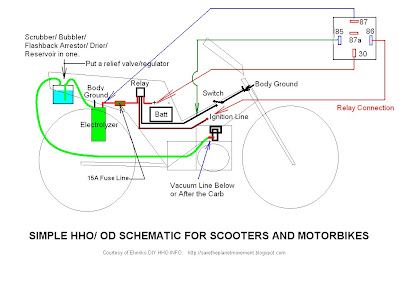
This is a very basic schematic for bikes.
HHO Chit Chat


Custom Search