Showing posts with label DIY HHO. Show all posts

8.31.2008

Slowly but Surely!


(Above is a Super 7 that experienced a thermal runaway on only 20gm. Baking Soda... see how the points are burned. But the good thing about the Super 7 is, it is not that sensitive. Once conditioned, you can reverse the polarity connections and still have no problems and even go back again to its old configuration and still work fine.)

You are now probably bombarded with the ideas that bigger is better... more is better... more LPMs', Gas flow and Bigger Bubbles is good.

I hate to burst the bubble. But contrary to what you are all led to believe.

Less is actually More! Small is actually Better! This is actually true in most and mainly on all cases. When I was first amazed with the incredible mileage gains I got from the HHO Purple Bug, I only had 0.1LPM's and no electrolytes in my system. I had a 1600 motor in the bug and it was used for racing... it normally make 6km to a liter of gas when I had this module hooked up to it, it made 12 km per liter. My unit isn't heating up, it didn't have thermal runaways nor meltdown happening.

Recently, I tried various configurations and also played with electrolytes... I was amazed with the gas production rates... but I am not impressed with the heat building up as well as the amperage rising. Definitely bad for the electrical system as well as the PVC Casing.

Again, I tried to do it with lesser electrolyte concentration... but it still went too hot. I guess, I will have to stick with less again. If it worked perfectly well the last time... then I must have been doing something right after all. Then why am I still entertaining other concepts, ways or techniques that have been problematic in the first place?

Perhaps, or maybe because I am feeling a bit competitive? I guess there really is no contest here about anything... but there is only one thing I am sure of. There is a silent race to make the world green.

The super 7 design which is my innovation... is actually an unpatented design and is also placed in open source. Though, a few examples were made and are in use. It is still a beta product. There is a challenge in casing improvement. It works passively and is designed to work on a fully saturated closed system. It also works well with an open system. The nice feature of this design is that it is a honeycomb configuration. It maximizes the usable space inside a 4" diameter circle with 7 bigger and 7 smaller tubes. The contacts are all TIG Welded for secured connections and better electrical energy flow, not to mention - Safety. It is made in a way that it allows physical extraction of HHO to be easier for engine intake Vacuum pressure.

The Super 7 builds up HHO a bit slower than all the other designs in the HHO Market since it is only designed to operate on tap water... a substitute electrolyte of a Distilled Water with a very few grams of Baking Soda can also be used. This will generate enough bubbles that are very fine. But when the vacuum extraction kicks in higher negative pressure is increased significantly and may and will also increase the amperage of the unit, the heat or thermal runaway will be way too much for the PVC casing to handle, wharfing may result which may cause water leakage.

The Super 7 draws an average of 2AMPS only... The Heat build-up is also moderate, a conditioned tube will not form muck anymore. This is a very reliable set up. This single unit is roughly equivalent to about 6 mason jars of the water4gas product using only normal tap water with very small AMPs draw.

At 0.10LPM of good quality HHO, we are certain of extracting about 1 liter of quality explosive HHO in 10 minutes or less. If this is spread over the entire use of the car in 10 minutes... we are definitely adding a liter of NOs-like gas in our operation. To use a multiple cell configuration... is to increase the LPM... I would go for this, but if I dont have enough Amps reserve in my Batteries, it will be raising a problem with faster discharging of the battery, the normal alternator charging will not be sufficient to compensate the ampere draw. But with a reliable PWM... results might be the same using a multi-cell array. For example, you want to make 1 LPM... then use a PWM (Pulse Width Motor) on your Single unit Super 7 cell... then you can get 1 LPM oh HHO; definitely, you will be getting more serious gains out of this. But again, timing is key. We need to adjust our engine timing according to the new fuel octane characteristics and of course, going back to the issue of battery discharging due to the ampere draw requirement of more cells.

But then again, If I were you, I would stick to making your first most reliable set up and use it for months first until you come to the point that you can confidently say... "It's time for an upgrade."

Better Slower but Surer... Haste makes waste.

8.09.2008

Warning! Used Electrolytes is Cancerous!

Here's a dangerous substance which is contained in the waste electrolytes that we throw out of our HHO electgrolyzers... they are called Chromium Hexavalents... they are normally brown in color... this muck that we see contains this substance. I manage to pick up some materials related to this as follows:

from Wikipedia:

"Hexavalent chromium (Cr(VI)) compounds are those which contain the element chromium in the +6 oxidation state.

Chromates, which are Chromium (VI) compounds, are often used as pigments for photography, and in pyrotechnics, dyes, paints, inks, and plastics. They can also be used for stainless steel production, textile dyes, wood preservation, leather tanning, and as anti-corrosion and conversion coatings. They are used as corrosion inhibitors, but due to their high levels of toxicity they are being replaced by alternatives.

Hexavalent chromium is recognized as a human carcinogen via inhalation.[1] Workers in many different occupations are exposed to hexavalent chromium. Occupational exposures occur mainly among workers who:

* handle dry chromate-containing pigments
* spray chromate-containing paints and coatings
* operate chrome plating baths
* weld, cut or grind chromium-containing metals such as stainless steel.

Within the European Union, the use of hexavalent chromium in electronic equipment is largely prohibited by the Restriction of Hazardous Substances Directive.

Toxicity

In an organism's cells, hexavalent chromium (Cr(VI))undergoes reduction, first to metastable pentavalent chromium (Cr(V)), then to trivalent chromium (Cr(III)). Trivalent chromium binds to proteins and creates haptens which trigger immune system reaction. Once developed, chrome sensitivity becomes fairly persistent; in such cases, even contact with chromate-dyed textiles or wearing of chromate-tanned leather shoes can cause or exacerbate contact dermatitis.

Hexavalent chromium compounds are genotoxic carcinogens. Chronic inhalation of hexavalent chromium compounds increases risk of lung cancer (lungs are especially vulnerable, followed by fine capillaries in kidneys and intestine). It appears that the mechanism of genotoxicity relies on pentavalent or trivalent chromium. According to some researchers, the damage is caused by hydroxyl radicals, produced during reoxidation of pentavalent chromium by hydrogen peroxide molecules present in the cell. Zinc chromate is the strongest carcinogen of the chromates used in industry. Soluble compounds, like chromic acid, are much weaker carcinogens.[1] Chromium(III)compounds are much less toxic than Chromium(VI) compounds.

Permissible Exposure Limit (PEL or OSHA PEL)

The OSHA PEL for airborne exposures to hexavalent chromium is 5 µg/m3 (0.005 mg/m3).[2]

Reaction with Vitamin C

Researchers have recently reported discovering that vitamin C reacts inside human lung cells with chromium(VI), causing massive DNA damage. Low doses of chromium(VI), combined with vitamin C, produce up to 15 times as many chromosomal breaks and up to 10 times more mutations, compared with cells lacking vitamin C. Outside cells, vitamin C actually protects against the cellular damage caused by hexavalent chromium.[3]

Chromium(VI) and drinking water

Hexavalent chromium is the substance against which Erin Brockovich campaigned. It was found in drinking water in the Southern California town of Hinkley. Chromium(VI) is carcinogenic in groundwater,[4] and the 0.58 ppm in the groundwater in Hinkley exceeded the Maximum Contaminant Level of 0.10 ppm currently set by the United States Environmental Protection Agency.[5] A similar case was discovered in 2007 in Asopos River, near Oinofyta, Greece and Brockovich is again focusing on it. [6]"

It is therefore imperative for all HHO experimenters to be conducting safety measures in handling this harmful chemical. Specialy in disposing their electrolytes to the ground.

A Good practive would be to put them in plastic containers with a mark.... you may also filter these water for the purpose of reusing them again in your electrolysers.

HHO containers must also bear a sticker to warn users of its danger to human handling.

Always wear the necessary protection gears in handling your HHO's.

7.25.2008

RunYourCarOnWaterFYI.com Has Opened Its Doors

RunYourCarOnWaterFYI.com Has Opened Its Doors

New website debunks both critics and scammers concerning legitimate run your car on water technology that is being used in thousands of vehicles today.

Highland, CO, July 23, 2008 --(PR.com)-- Run Your Car on Water FYI (runyourcaronwaterfyi.com) has opened its online doors as a premier web property where one can separate fact from fiction in regard to HHO technology. Run Your Car on Water FYI compares and contrasts gasoline-powered vehicles that use HHO generators with hydrogen cars and mythical perpetual motion machines.

According to General Manager Craig Appleton, “There has been so many scams and misinformation in this field, we felt compelled to put up a website that will put the record straight. HHO technology is real, viable and is in thousands of vehicles now, saving businesses and consumers gas mileage and dollars at the pump.”

The intent of Run Your Car on Water FYI is to separate the hyperbole from the hydrogen. HHO generators are aftermarket devices one can put on one’s gasoline-powered car or diesel vehicle that uses a small amount of water, electrolyzes it, and injects the resulting HHO gas into the engine’s intake system.

The liquid H2O is transformed into HHO gas and this assists the engine to burn more cleanly and at lower temperatures, which helps to increase gas mileage. It is the mission of this website to debunk both the critics who say that run your car on water technology cannot work and the scammers who confuse HHO technology with hydrogen cars and the mythical perpetual motion water car.

The runyourcaronwaterfyi.com website talks about the Stan Meyer water car and conspiracy theories surrounding his death, the Japanese Genepax water car, Brown’s Gas and other related technology.

According to Appleton, “The reason this technology hasn’t taken off yet is because there is so much misinformation floating around that people feel they are being scammed when they come to most websites. Our intent is to legitimize this viable technology through public education.”

Run Your Car on Water FYI
Craig Appleton
909-798-2460
replyto@runyourcaronwaterfyi.com
www.runyourcaronwaterfyi.com

7.22.2008


Rob Matthies interviewed in CBC Radio, Vancouver Canada.

Talks about Running your Car with Water... and explains Why water induction is not harmful to our engines.

Rob is the pioneer in running the most cheapest to operate Electric Vehicle in the world that runs on revived dead batteries.

He also lives outside the energy grid... his house is powered with solar, hydrogen, revived batteries technology.

If you wish to contact Rob about his revived battery technology for your electric vehicles... this is his number.

Rob conducts weekly seminars and solar roadshows all over Canada, raising up awareness of school children and folks about Solar Power, Revived Batteries, alternative energy including HHO, Hydrogen and Oxygen Generators for DIY or experimenters.

Courtesy of Van Gadgeteers Club, Canada. (604) 739-7717

7.16.2008

Free Hydrogen Power

Free Hydrogen is not really free... and it is not really for everyone.

The Conspiracy Theorists might have a more darker thoughts about this statement. And the Naysayers... well, they will keep saying ney or nay.

At any rate, I am writing this blog merely for the purpose of sharing information to the worthy seekers, that's you!

You probably think - there is someone out there who is actually sharing information for free!

Yes I am... and I do not intend to make this a long and uncomfortable read for you.

Don't worry, I wont be telling you what HHO, Hydrogen, Oxygen, AF Ratios, Thermodynamics, Over Unity, AMPS Draw or anything of that sort here. You probably have bombarded yourself with information in other previous readings.

The question we want to address here is... "Can we actually make our own HHO system in our cars for free?"

Well, the answer is... perhaps it's not entirely free... but you will be able to Do everything yourself!.

First things first; Materials...

We will be building a small HHO brick... small but strong. With a standard configuration of (+nn-nn+):

1. Stainless Steel 316 or 301 1mm thick plates (2" x 3" about 5 pieces) (Hand sanded, drilled with 6mm dia. holes on all 4 corners with about 10mm clearance on the edges.

2. Plastic Bolts and Nuts 4 pcs.... (6mm dia. threads 30mm in length or more) (plastic flat washers about 40 pcs. Plastic Nuts about 8 pcs.)

3. Stainless Steel wire eye terminals... (6.5mm inner diameter .5mm thk.) 3 pcs.

4. Stainless wires (if you can get one) (cut to length)

5. Stainless Steel Bolts and Nuts with flat washers and lock washers (6mm dia. 25mm) about 2 pcs. bolts and washers and 4 pcs. nuts.

6. HDPE Plastic Jar or Container... preferably cylindrical jar with threaded cap or lid. (about 4" x 4" x 8") This will serve as your electrolyser container. (Drill 2 holes for the stainless bolts and 2 holes for the Brass fittings.
(1 Center hole for the HHO Gas output fitting... and one hole near the edge for the other breather inlet fitting. and the two smaller holes for the electrodes with equidistant locations... they need to be far apart but keep a clearance of about 15mm from the edges.

7. Brass Fittings (3/16" or 1/4") 2 pcs.

8. Fuel Hose... I recommend those black rubber hose or Vacuum hoses. (cut to length)

9. Automotive Wires with Eye Terminals (number 16, cut to length)

10. Fuse holder with fuse(15 AMPS, in line type)

11. For your bubbler, you may use the plastic (HDPE) reservoir similar to your radiator coolant reservoir.

As soon as you have the above materials in your table... the next step is to build your first Home-made HHO Generator - you can actually use right away!

Please stay tuned for the next article where I will be teaching you a step by step procedure on how you can build you first HHO - Hydrogen on demand module for your car.

Please be patient... and don't blow things up just yet!

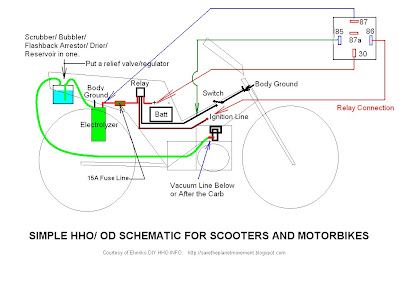
Simple Schematic for Scooters/ Motor Bikes

Simple Schematic for Scooters/ Motor Bikes
This is a very basic schematic for bikes.
Custom Search