
1.20.2011
11.10.2010
10.20.2010
FUKAI hydrogen energy from Japan
This technology can be used to generate hydrogen simply by adding either aluminum or magnesium to functional water.
Two liters of hydrogen can be generated for each gram of aluminum, while each gram of magnesium will generate 3.3 liters of hydrogen.
This will allow the production of 1kwh of electricity at a low cost of approximately 15 yen (calculated based on the use of unused aluminum powder).
This cost can be reduced even further by using recycled aluminum cans.
The experiment in the following video shows how quickly and easily hydrogen can be generated with this technology.
Functional water allows hydrogen to be generated in large volumes.
The bonds of hydrogen molecules in functional water are easily broken, and the reaction with either aluminum or magnesium produces a large volume of hydrogen.
Functional water is produced by simply passing tap water through an apparatus that contains natural minerals.
Elaborate facilities and laboratories are not required.
Since functional water can be produced simply by passing tap water through an apparatus that contains natural minerals, there is no energy cost.
"If we use this technology in the future, we will be able to drive cars without gasoline or electricity, using only water.
Water will become an energy resource, replacing petroleum-based fuel.
We are currently researching and developing technology to generate hydrogen at zero cost.
Someday it will be possible for each household to generate its own hydrogen. The private generation of electricity using hydrogen is not an impossible dream."
Two liters of hydrogen can be generated for each gram of aluminum, while each gram of magnesium will generate 3.3 liters of hydrogen.
This will allow the production of 1kwh of electricity at a low cost of approximately 15 yen (calculated based on the use of unused aluminum powder).
This cost can be reduced even further by using recycled aluminum cans.
The experiment in the following video shows how quickly and easily hydrogen can be generated with this technology.
Functional water allows hydrogen to be generated in large volumes.
The bonds of hydrogen molecules in functional water are easily broken, and the reaction with either aluminum or magnesium produces a large volume of hydrogen.
Functional water is produced by simply passing tap water through an apparatus that contains natural minerals.
Elaborate facilities and laboratories are not required.
Since functional water can be produced simply by passing tap water through an apparatus that contains natural minerals, there is no energy cost.
"If we use this technology in the future, we will be able to drive cars without gasoline or electricity, using only water.
Water will become an energy resource, replacing petroleum-based fuel.
We are currently researching and developing technology to generate hydrogen at zero cost.
Someday it will be possible for each household to generate its own hydrogen. The private generation of electricity using hydrogen is not an impossible dream."
The Rainbow Ensemble
ISIS Report 20/10/10
Water’s Quantum Jazz
The Rainbow Ensemble
##################
How water keeps ‘most everything in the cell dancing most of the time, and
what’s the cell really like. Dr. Mae-Wan Ho
We are now ready to venture inside the cell and see how everything, the rainbow
ensemble, can do water’s quantum jazz together. We start by considering the
interaction of water with ions and proteins.
Salt out only if you must
The interaction of charged ions with water and proteins is at the heart of many
signal transduction processes in the cell. Enzymes and cofactors are highly
specific in their requirements for metal ions; while the addition of a phosphate
group to proteins and metabolites – phosphorylation - are widely involved in
activating enzyme pathways of biosynthesis and energy metabolism. What is the
origin of these ion-specific effects? At a more fundamental level, why do
different salts vary so much in solubility? And why do some salts precipitate
proteins from solution more so than others?
Numerous studies have confirmed that small ions of high charge density are
kosmotropes (order inducing) and bind water molecules strongly; while large ions
of low charge density are chaotropes (disorder inducing) and bind water
molecules weakly relative to the strength with which water molecules form
hydrogen bonds with one another (see [1] Dancing with Ions, SiS 48). Kosmotropes
tend to attract a solvation shell with more water molecules, while chaotropes
have small solvation shells with less water molecules. But that is only half the
story. The other half of the story begins with how ions interact with proteins.
Franz Hofmeister, a Czech scientist in the late 19th century, found that some
salts helped egg white proteins to dissolve in water, while others caused the
proteins to precipitate out, and there were those that had effects in between.
He ranked the ions according to their ability to “salt-out” and “salt-in”, which
resulted in the Hofmeister series. The Hofmeister series is also correlated with
the ability of the ions to induce protein unfolding, coalescence of bubbles and
many other phenomena, though there has never been a satisfactory explanation
[2].
Kim Collins at University of Maryland Medical School, Baltimore, USA, may have
found the answer [3, 4], and it is related to the ions’ affinity for water.
When pairs of oppositely charged ions have similar affinities for water,
something special happens: they come out of their solvation shells, join up and
neutralize each other. That’s because they can just as easily form intimate
partners with each other as with water molecules; exchanging water molecules for
the counter-ion does not cost anything in energetic terms. This ‘Law of Matching
Water Affinities’ appears to explain why certain salts are less soluble than
others, and why some salts precipitate proteins out of solution while others
help them dissolve. The answer is that only neutral molecules precipitate (or
crystallize) out of solution; neutral molecules have much lower solubility.
More specifically, according to Collins, a radius of 1.06 ? separates small
monovalent cations from large ones, and a radius of 1.78 ? separates small
monovalent anions from large ones. Small monovalent ions are strongly hydrated,
while large monovalent ions are weakly hydrated (see Fig. 1). For example, LiF
contains small monovalent ions that readily come out of their hydration shells
to pair up as ‘contact ion pairs’, it has a solubility of only 0.1 M. In
contrast, CsF has a large cation and a small anion, and do not pair up in
solution; it has a solubility of 24.2 M.
Figure 1 Monovalent kosmotropes & chaotropes ordered by size; the size of their
hydrated ion is in inverse order
Proteins have strong negatively charged carboxylate groups (COO-) on their side
chains that pair up well with kosmotrope cations, so Na+ salts out proteins,
while a chaotrope such as Cs+ salts them in. Similarly, Ca2+ is well-matched to
carboxylate in water affinity and will also salt out proteins.
Read the rest of this article here
http://www.i-sis.org.uk/theRainbowEnsemble.php
This is the fourth article in the series Water’s Quantum Jazz
Water’s Quantum Jazz
The Rainbow Ensemble
##################
How water keeps ‘most everything in the cell dancing most of the time, and
what’s the cell really like. Dr. Mae-Wan Ho
We are now ready to venture inside the cell and see how everything, the rainbow
ensemble, can do water’s quantum jazz together. We start by considering the
interaction of water with ions and proteins.
Salt out only if you must
The interaction of charged ions with water and proteins is at the heart of many
signal transduction processes in the cell. Enzymes and cofactors are highly
specific in their requirements for metal ions; while the addition of a phosphate
group to proteins and metabolites – phosphorylation - are widely involved in
activating enzyme pathways of biosynthesis and energy metabolism. What is the
origin of these ion-specific effects? At a more fundamental level, why do
different salts vary so much in solubility? And why do some salts precipitate
proteins from solution more so than others?
Numerous studies have confirmed that small ions of high charge density are
kosmotropes (order inducing) and bind water molecules strongly; while large ions
of low charge density are chaotropes (disorder inducing) and bind water
molecules weakly relative to the strength with which water molecules form
hydrogen bonds with one another (see [1] Dancing with Ions, SiS 48). Kosmotropes
tend to attract a solvation shell with more water molecules, while chaotropes
have small solvation shells with less water molecules. But that is only half the
story. The other half of the story begins with how ions interact with proteins.
Franz Hofmeister, a Czech scientist in the late 19th century, found that some
salts helped egg white proteins to dissolve in water, while others caused the
proteins to precipitate out, and there were those that had effects in between.
He ranked the ions according to their ability to “salt-out” and “salt-in”, which
resulted in the Hofmeister series. The Hofmeister series is also correlated with
the ability of the ions to induce protein unfolding, coalescence of bubbles and
many other phenomena, though there has never been a satisfactory explanation
[2].
Kim Collins at University of Maryland Medical School, Baltimore, USA, may have
found the answer [3, 4], and it is related to the ions’ affinity for water.
When pairs of oppositely charged ions have similar affinities for water,
something special happens: they come out of their solvation shells, join up and
neutralize each other. That’s because they can just as easily form intimate
partners with each other as with water molecules; exchanging water molecules for
the counter-ion does not cost anything in energetic terms. This ‘Law of Matching
Water Affinities’ appears to explain why certain salts are less soluble than
others, and why some salts precipitate proteins out of solution while others
help them dissolve. The answer is that only neutral molecules precipitate (or
crystallize) out of solution; neutral molecules have much lower solubility.
More specifically, according to Collins, a radius of 1.06 ? separates small
monovalent cations from large ones, and a radius of 1.78 ? separates small
monovalent anions from large ones. Small monovalent ions are strongly hydrated,
while large monovalent ions are weakly hydrated (see Fig. 1). For example, LiF
contains small monovalent ions that readily come out of their hydration shells
to pair up as ‘contact ion pairs’, it has a solubility of only 0.1 M. In
contrast, CsF has a large cation and a small anion, and do not pair up in
solution; it has a solubility of 24.2 M.
Figure 1 Monovalent kosmotropes & chaotropes ordered by size; the size of their
hydrated ion is in inverse order
Proteins have strong negatively charged carboxylate groups (COO-) on their side
chains that pair up well with kosmotrope cations, so Na+ salts out proteins,
while a chaotrope such as Cs+ salts them in. Similarly, Ca2+ is well-matched to
carboxylate in water affinity and will also salt out proteins.
Read the rest of this article here
http://www.i-sis.org.uk/theRainbowEnsemble.php
This is the fourth article in the series Water’s Quantum Jazz
Subscribe to:
Posts (Atom)
Simple Schematic for Scooters/ Motor Bikes
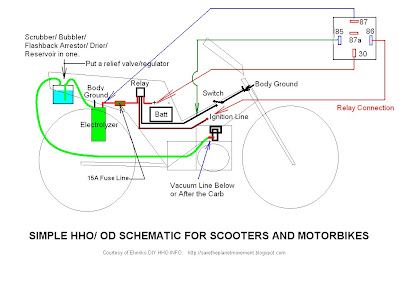
This is a very basic schematic for bikes.
HHO Chit Chat


Custom Search